
Caring For Infants: A Gentle, Evidence-Based Approach for New Parents
-

- Feelings
Introduction: Caring For Infants
From Sleepless Nights to First Smiles – Everything You Need to Know About Caring for Infants. The moment you bring your newborn home, a beautiful and overwhelming reality sets in: this tiny, fragile human is entirely dependent on you. Your heart swells with love, but your mind races with questions. Am I holding them correctly? Is she eating enough? Why is he crying? Am I supposed to wake a sleeping baby?
If you’ve found yourself staring at your infant at 3 AM, searching for answers on your phone, you are not alone. Caring for infants is one of the most rewarding and yet most anxiety-inducing journeys a person can take. The good news is that human beings have been doing this for millennia, and you are more capable than you think.
This guide is designed to be your calm, reassuring companion through the first year of your baby’s life. We’ll cover everything from newborn care basics like feeding, sleeping, and diapering, to understanding developmental milestones, keeping your baby safe, and—perhaps most importantly—taking care of your own mental health along the way.
Whether you are a first-time parent, a grandparent relearning the ropes, or a caregiver stepping into this role, this article is for you. Let’s take a deep breath and begin.
Understanding Your Newborn – The First Few Weeks
The first few weeks after birth are often called the “fourth trimester,” and for good reason. Your baby is adjusting to life outside the womb, and you are adjusting to life as a parent. Neither of you needs to be perfect.
What Your Newborn Is Like
In the first weeks, caring for infants, you will:
- Sleep most of the day (16–18 hours), but in short bursts of 2–4 hours.
- Feed frequently, often every 2–3 hours (sometimes more).
- Lose a small amount of birth weight, then regain it by week two.
- Cry is their primary form of communication.
- Show reflexes like rooting (turning toward a touch on the cheek) and grasping.
Understanding that these behaviors are normal is the first step to reducing anxiety.
Bonding and Attachment
Bonding doesn’t always happen instantly, and that’s okay. Infant bonding is a process, not a single moment. Skin-to-skin contact, gentle talking, feeding, and simply holding your baby all build a secure attachment over time. This secure attachment lays the foundation for your baby’s emotional and social development.
Practical bonding tips:
- Hold your baby skin-to-skin for at least 20–30 minutes daily.
- Look into their eyes while feeding or rocking them.
- Respond consistently to their cries (you cannot spoil a newborn).
- Talk, sing, or read aloud—your voice is their favorite sound.
Caring for Infants – Breastfeeding, Formula, and Beyond
-

- Crying for food
Feeding is at the heart of infant care. It nourishes your baby’s body and brain, supports their immune system, and provides countless moments of closeness. There is no single “right” way to feed your baby, only what works best for your family.
Breastfeeding Basics+
Breast milk is uniquely tailored to your baby’s needs, providing antibodies, enzymes, and optimal nutrition. The World Health Organization recommends exclusive breastfeeding for the first six months, with continued breastfeeding alongside solid foods for up to two years or beyond.
Getting started:
- Feed on demand, watching for early hunger cues like smacking lips, rooting, or putting hands to mouth (crying is a late cue).
- Aim for 8–12 feedings in 24 hours in the early weeks.
- Ensure a good latch: baby’s mouth covers most of the areola, not just the nipple, and their chin touches your breast.
- Expect some initial soreness, but sharp or persistent pain warrants a consultation with a lactation specialist.
Common challenges and solutions:
- Low supply: Most perceived low supply is not real. Nurse frequently, stay hydrated, and consult a lactation consultant before supplementing.
- Engorgement: Nurse or pump to relieve pressure; use cold compresses after feeding.
- Mastitis: A painful, red, swollen breast with flu-like symptoms requires medical attention.
Formula Feeding: Nurturing a newborn
Infant formula is a safe, nutritionally complete alternative to breast milk. Modern formulas are carefully regulated to meet your baby’s needs, and many healthy, thriving babies are exclusively formula-fed.
Formula feeding tips:
- Choose a standard cow’s milk-based iron-fortified formula unless your pediatrician recommends otherwise.
- Follow mixing instructions precisely—too much water dilutes nutrients, too little can stress the kidneys.
- Use the prepared formula within one hour of starting a feeding, or within 24 hours if refrigerated.
- Warm bottles in a bowl of warm water (never a microwave, which creates hot spots).
Combination Feeding
Many families successfully combine breastfeeding and formula. This can mean nursing most of the time with occasional formula top-ups, or offering formula for certain feeds. The key is to maintain your milk supply if you wish to continue breastfeeding—your body produces milk based on demand.
Introduction to Solid Foods
-

- Solid food
Around six months of age, most babies are ready for complementary foods. Signs of readiness include:
- Sitting up with minimal support.
- Good head and neck control.
- Showing interest in food (reaching for it, watching you eat).
- The tongue-thrust reflex (pushing food out with the tongue) has diminished.
First foods are typically single-ingredient, iron-rich purees (such as iron-fortified cereal, pureed meat, beans, or lentils) or soft fruits and vegetables. Introduce one new food at a time and wait 3–5 days before introducing another to watch for allergic reactions.
Newborn Sleep –Managing infant needs
-

- Sleeping Baby with parents
Sleep is the topic that keeps new parents up at night—ironically. Understanding infant sleep patterns can save your sanity.
Normal Infant Sleep Is Not Adult Sleep
Babies spend about 50% of their sleep time in REM (active) sleep, which is lighter and more easily disturbed. They also have much shorter sleep cycles—about 50–60 minutes compared to 90 minutes for adults. This means they wake more frequently, and that is entirely normal.
Safe Sleep Guidelines (The ABCs)
To reduce the risk of Sudden Infant Death Syndrome (SIDS) and accidental suffocation, follow these safe sleep for babies guidelines:
- Alone: No blankets, pillows, bumpers, stuffed animals, or sleep positioners.
- Back: Always place your baby on their back for every sleep, including naps.
- Crib: Use a firm, flat mattress with a fitted sheet. The crib should meet current safety standards.
Room-sharing (baby in their own crib or bassinet in your room) is recommended for at least the first six months, but bed-sharing is associated with increased SIDS risk and is not advised.
Realistic Sleep Expectations by Age
| Age | Total Sleep (24 hrs.) | Nighttime Sleep | Daytime Naps |
| 0–8 weeks | 16–18 hours | Broken into 2–4 hour segments | 4–6 naps |
| 2–4 months | 14–16 hours | 4–6 hour stretches possible | 3–4 naps |
| 4–6 months | 14–15 hours | 6–8 hour stretches | 2–3 naps |
| 6–12 months | 13–14 hours | 8–10 hours with possible wake-ups | 2 naps |
How to Encourage Healthy Sleep Habits
You cannot “train” a newborn, but you can lay the foundation:
- Learn to distinguish drowsiness from sleep. Put your baby down drowsy but awake when possible.
- Establish a simple, consistent bedtime routine (bath, book, lullaby, bed).
- Expose your baby to natural light during the day and keep nights dark and boring.
- Respond to cries promptly in the early months—comfort and feeding are not “bad habits.”
Diapering, Bathing, and Daily Care
The hands-on tasks of daily infant care become second nature with practice. Here’s what you need to know.
Diapering Basics
Whether you choose cloth or disposable diapers, expect to change 8–12 diapers per day in the early months.
Preventing and treating diaper rash:
- Change diapers frequently, ideally as soon as they are wet or soiled.
- Clean gently with water and a soft cloth or alcohol-free wipes.
- Pat dry (don’t rub) before applying a barrier cream containing zinc oxide.
- Give your baby diaper-free time on a waterproof pad to let the skin breathe.
If a rash persists for more than a few days, becomes bright red with bumps, or includes blisters or pus, consult your pediatrician—it could be a yeast infection requiring medication.
Bathing Your Baby
-

- Bathing time
Until the umbilical cord stump falls off (usually by 2 weeks), give sponge baths only. After that, tub baths can begin.
Step-by-step bathing:
- Gather supplies: mild, fragrance-free baby wash, soft washcloth, two towels, a clean diaper, and clothes.
- Fill the baby tub or sink with 2–3 inches of warm water (test with your wrist or elbow—it should feel warm, not hot).
- Support your baby’s head and neck at all times. Never leave a baby unattended in water, even for a second.
- Wash from cleanest to dirtiest: face, then body, then diaper area.
- Keep baths short (5–10 minutes) to prevent skin drying out.
How often? Two to three times per week is sufficient for most babies. Daily baths can dry out delicate skin unless you use minimal soap and apply moisturizer afterward.
Cord and Circumcision Care
- Umbilical cord stump: Keep it dry and clean. Fold the diaper down below it. It will fall off on its own in 1–3 weeks. A small amount of dried blood is normal.
- Circumcision care (if applicable): Follow your pediatrician’s instructions. Typically, this involves applying petroleum jelly to the tip with each diaper change for several days.
Nail Care
Baby nails grow quickly and can be surprisingly sharp. File them with an emery board or use baby nail scissors while your baby is sleeping or feeding. Avoid biting their nails, which can introduce bacteria.
Health, Wellness, and When to Call the Doctor
-

- Doctor Time
Feeling uncertain about infant health is universal. Knowing what’s normal and what requires medical attention will give you confidence.
Well-Baby Visits and Vaccinations
Your baby will see the pediatrician frequently in the first year: at birth, 2–4 days, 1 month, 2 months, 4 months, 6 months, 9 months, and 12 months. These visits track growth, development, and administer infant vaccinations according to the recommended schedule.
Vaccinations protect your baby from serious diseases like whooping cough, measles, polio, and hepatitis B. Side effects are typically mild (low-grade fever, fussiness, soreness at the injection site) and far less risky than the diseases they prevent.
Common Infant Illnesses and Concerns
Fever: In a baby under 3 months old, any fever (rectal temperature of 100.4°F / 38°C or higher) is a medical emergency requiring immediate evaluation. For older infants, fever is less concerning but still warrants a call to the doctor, especially if accompanied by lethargy, poor feeding, or breathing difficulty.
Colds and congestion: Use a cool-mist humidifier, saline drops, and a bulb syringe to clear nasal passages. Do not use over-the-counter cold medicines in infants.
Jaundice: Yellowing of the skin and eyes is common in newborns. Mild jaundice resolves with frequent feeding. Severe jaundice requires treatment with phototherapy.
Reflux: Spitting up after feeds is normal for most babies. If your baby is in obvious pain, not gaining weight, or spitting up forcefully (projectile), consult your pediatrician.
When to Seek Emergency Care
Trust your instincts. Seek immediate medical attention if your baby:
- Has a fever in children under 3 months old.
- Is struggling to breathe (grunting, flaring nostrils, chest retractions).
- Has blue lips or skin.
- Is unresponsive or difficult to wake.
- Has a seizure.
- Is vomiting green fluid or blood?
- Has a bulging or sunken soft spot (fontanelle).
Developmental Milestones – What to Expect in the First Year
Watching your baby grow and learn new skills is one of the greatest joys of infant development. Remember that milestones are ranges, not deadlines. Some babies walk at 9 months; others don’t walk until 15 months. Both can be perfectly normal.
0–3 Months: The Social Smile Emerges
- Lifts head briefly during tummy time.
- Follows faces and high-contrast objects with eyes.
- Startles at loud noises.
- Begins to smile socially (around 6–8 weeks).
- Makes cooing sounds.
3–6 Months: Reaching and Rolling
- Pushes up on elbows during tummy time.
- Rolls from tummy to back, then back to tummy.
- Reaches for and grasps toys.
- Laughs and squeals.
- Recognizes familiar faces.
6–9 Months: Sitting and Babbling
- Sits without support.
- Transfers objects from hand to hand.
- Responds to their own name.
- Babbles consonant sounds (“ba-ba,” “da-da”).
- May show stranger anxiety.
9–12 Months: Crawling, Cruising, and First Words
- Crawls (not all babies crawl—some scoot or go straight to walking).
- Pulls to stand and cruises along furniture.
- May take first independent steps.
- Says “mama” or “dada” with meaning.
- Points to objects of interest.
- Plays peek-a-boo.
Encouraging Development through Play
-

- Playing time
The best “baby toys” are often simple: your face, your voice, a soft ball, a board book, a plastic spoon. Follow your baby’s lead. If they drop a spoon 20 times, they are learning about gravity and cause-and-effect—not trying to annoy you.
Tummy time is essential for strengthening neck, back, and shoulder muscles. Start with 1–2 minutes several times a day and work up to 15–20 minutes total by 3 months. If your baby hates it, try short sessions on your chest or across your lap.
Infant Safety – Baby Proofing Your Home and Beyond
Baby safety is not about wrapping your child in bubble wrap. It’s about creating an environment where they can explore safely.
Car Seat Safety
Motor vehicle crashes are a leading cause of injury to children. A properly installed infant car seat reduces the risk of death by 71% for infants.
Non-negotiable:
- Rear-facing until at least age 2 (or longer, following seat height/weight limits).
- Installed in the back seat, never the front seat, with an active airbag.
- Harness straps at or below shoulder level for rear-facing.
- Chest clip at armpit level.
- No bulky winter coats under the harness.
Many fire stations and hospitals offer free car seat inspections.
Home Babyproofing by Age is part of caring for infants
Newborn to 4 months: Focus on safe sleep (see Part 3) and preventing falls (never leave the baby unattended on a changing table or bed).
4–8 months (starting to roll and scoot):
- Secure furniture to walls (dressers, bookcases, TVs).
- Use outlet covers.
- Install safety gates at the top and bottom of the stairs.
- Keep small objects (coins, button batteries, magnets) out of reach.
8–12 months (crawling and cruising):
- Add cabinet and drawer locks.
- Cover sharp corners on furniture.
- Move household cleaners and medications to high cabinets.
- Set the water heater to 120°F (49°C) to prevent scalding.
- Anchor cords for blinds and curtains.
In caring for infants, prevent choking hazards
-

- Choking care
-
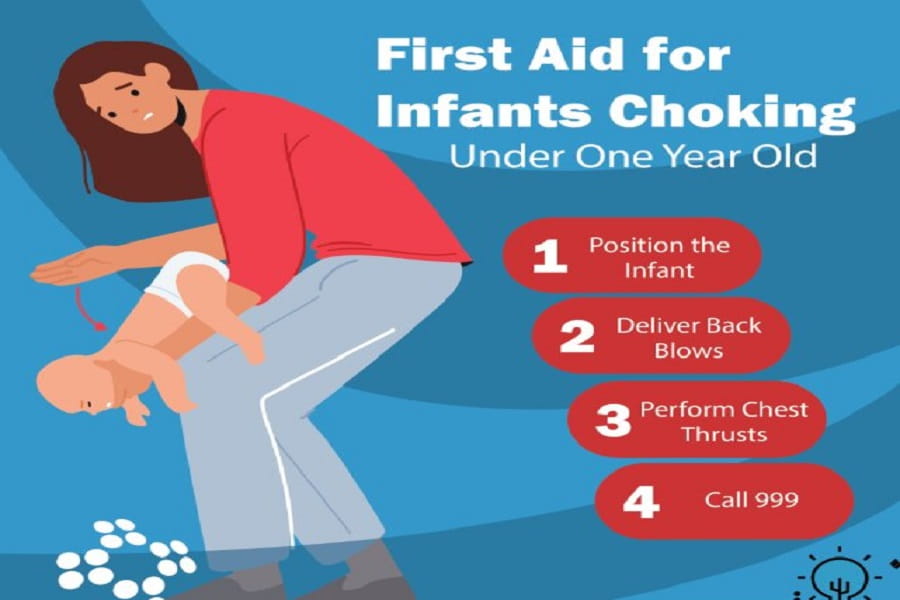
- Choking care
The most common cause of non-fatal choking in infants is food.
Avoid:
- Whole grapes, cherry tomatoes (cut lengthwise into quarters).
- Hot dogs (cut lengthwise, then into small pieces).
- Popcorn, nuts, seeds, hard candy.
- Raw chunks of hard vegetables.
- Sticky foods like marshmallows or a spoonful of nut butter.
Also, keep an eye on small toy parts, coins, batteries, and balloons.
Water and Drowning Prevention: Caring for Infants
Drowning is silent and can happen in seconds. Never leave your baby unattended near water, including bathtubs, buckets, toilets, and pools. Empty buckets immediately after use. Install toilet locks. For home pools, use four-sided fencing with a self-closing, self-latching gate.
Parental Well-Being – You Matter Too
You cannot pour from an empty cup. Caring for infants is exhausting, and parental mental health is just as important as your baby’s physical health.
Understanding Postpartum Mood Disorders
“Baby blues” (mood swings, tearfulness, anxiety) affect up to 80% of new mothers and typically resolve within two weeks. Postpartum depression (PPD) is different—it is more intense, longer-lasting, and requires treatment.
Signs of PPD (in mothers or non-birthing parents):
- Persistent sadness, emptiness, or hopelessness.
- Loss of interest in activities you once enjoyed.
- Changes in appetite or sleep (beyond normal newborn disruption).
- Overwhelming fatigue or loss of energy.
- Feeling worthless or guilty.
- Difficulty bonding with the baby.
- Thoughts of harming yourself or the baby.
Postpartum anxiety is equally common and may involve racing thoughts, constant worry, physical symptoms like a racing heart, or intrusive thoughts.
What to do: Talk to your healthcare provider. PPD is treatable with therapy, medication, support groups, or a combination. It is not your fault, and you are not weak for needing help.
The Non-Birthing Parent
Partners also experience emotional challenges—anxiety, depression, exhaustion, and a sense of loss of their previous life. Their role in supporting the infant and the birthing parent is vital, and their mental health deserves attention, too.
Practical Self-Care for Sleep-Deprived Parents
-

- Parents & babies sleeping
Self-care looks different with a baby. It’s not hour-long bubble baths (though those are lovely). It’s:
- Accepting help when offered (and asking when it’s not).
- Sleep when the baby sleeps, even if that means a 20-minute nap.
- Eating something—anything—regularly. Frozen meals, delivery, and peanut butter sandwiches count.
- Showering every day or two, even if the baby cries for five minutes in a safe bassinet.
- Finding one small moment of joy daily (a cup of hot coffee, a text to a friend, three minutes of a favorite song).
Caring for infants: when and how to ask for Help
Make a list of 3–5 people you can call before the baby arrives. Then use it. Specific asks work better than general ones:
- “Can you bring dinner on Tuesday?”
- “Could you hold the baby for 30 minutes so I can shower?”
- “Would you pick up a prescription for me?”
If you don’t have nearby family, look for postpartum doulas, parent groups (online or in person), or your place of worship.
Frequently Asked Questions about Caring for Infants
How often should I bathe my newborn?
Two to three times per week is sufficient. Between baths, clean the face, neck folds, and diaper area with a soft, damp cloth.
Is it okay to let my baby cry it out?
Not in the newborn period. For babies under 4–6 months, crying is communication, not manipulation. Responding promptly builds trust and secure attachment. Formal sleep training methods are generally not recommended until at least 4–6 months, and even then, many parents choose gentler approaches.
How do I know if my baby is getting enough milk?
Signs of adequate intake include: 6+ wet diapers per day (by day 5), 3+ yellow, seedy stools per day (in the early weeks), steady weight gain, and meeting developmental milestones. Your baby should seem satisfied after feeds.
When should I worry about a fever?
For infants under 3 months, any fever (100.4°F/38 °C rectal or higher) is an emergency. For older infants, call the doctor if the fever lasts more than 24–48 hours, is very high (over 104°F/40 °C), or is accompanied by lethargy, poor feeding, or breathing trouble.
How can I prevent flat head syndrome (positional plagiocephaly)?
Offer plenty of supervised tummy time when awake, alternate the direction your baby lies in the crib (feet at one end, then the other), and vary the side you hold and feed them on. Avoid too much time in car seats, swings, and bouncers when not traveling.
Conclusion: Caring for Infants
-

- Nice feelings for parents
Caring for infants is not about perfection. It’s about presence. It’s about showing up, day after day, with a willingness to learn, to make mistakes, and to love fiercely through the chaos.
You will misread a cry, forget to pack the diaper bag, or accidentally put the onesie on backwards at 2 AM. And none of that matters. What matters is that your baby knows, in their bones, that they are safe, that they are fed, that they are held, and that they are loved.
The first year moves faster than you can imagine. One day, you are cradling a 7-pound newborn who fits in the crook of your arm; the next, you are chasing a crawling, babbling explorer across the living room floor. In the hardest moments—the sleepless nights, the endless crying, the worry that you’re doing it all wrong—remember this: you are exactly what your baby needs.
Trust your instincts. Ask for help without shame. And take a moment, even today, to look at your baby and marvel at what you’ve already done together. You’ve got this. One feeding, one nap, one tiny smile at a time.
https://shorturl.fm/0DSYd
https://shorturl.fm/BXzuA